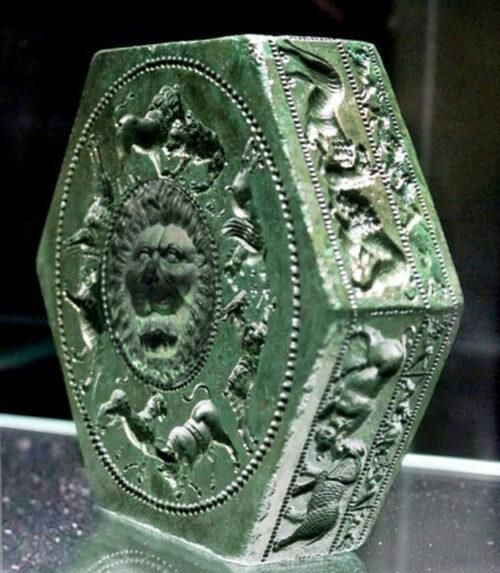
A unique bronze hexagonal mold used for making decorative and jewelry items, Dacia (modern-day Romania), circa 100 BC.
It was used to make several dozen stamps and casting molds. This priceless artifact was discovered under the roots of a tree blown down by a strong wind at the Sarmizegetusa Regia archaeological site in Romania.
This mold likely originated in a local Dacian jewelry workshop. It features a number of real and mythological animals, including lions, tigers, panthers, rhinoceroses, hippopotamuses, bears, boars, wolves, aurochs, antelopes, and... one rabbit.
The mold also features three types of griffin: the vulture-vulture, the lion-griffin, and the wolf-griffin, a type of griffin typical of the northern Black Sea region.
The matrix weighs approximately 8 kg and has eight faces, two of which are hexagonal. Its thickness is approximately 5 cm.
It was created and used in the first century BCE. This discovery in the capital of the Dacian Kingdom is evidence of this region's connection to the artistic and high-tech cultural space of antiquity.
Museum of Dacian and Roman Civilization, Deva County, Romania
_____
#historia #history #metaldetecting #mydigworld #sword #dirtfishing #hobbydetecting #gold #coinhunting #relichunting #Archaeology #HistoricalArtifacts #museums
_____
#historia #history #metaldetecting #mydigworld #sword #dirtfishing #hobbydetecting #gold #coinhunting #relichunting #Archaeology #HistoricalArtifacts #museums