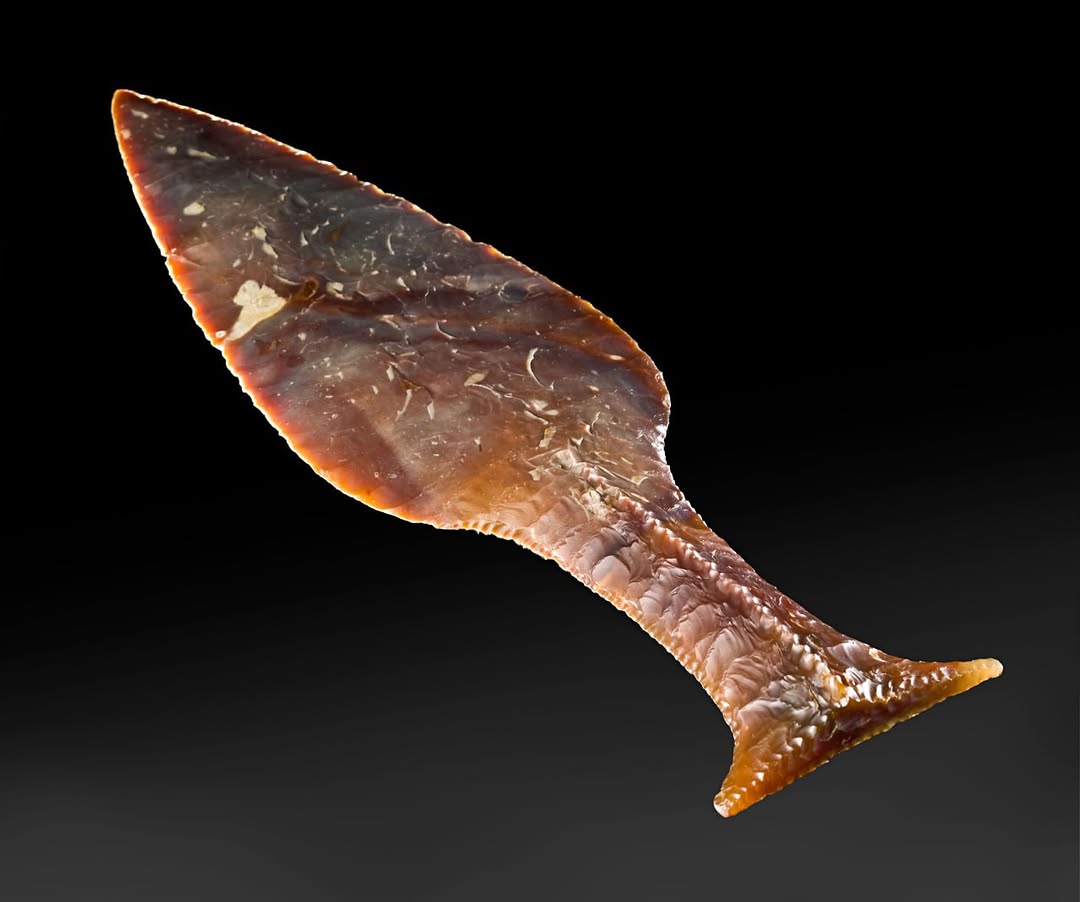
The Hindsgavl Dagger (Danish: Hindsgævldolken) is arguably one of the finest flint daggers ever made. Denmark, Eneolithic (Late Copper Age), c. 1900–1800 BC.
The dagger was discovered in 1867 by a young boy while walking on the island of Fænø in the Little Belt Strait. It was lying in a field belonging to the Hindsgavl estate. Excited by his find, the boy reportedly exclaimed, “Look, Mother, what a beautiful stone!” The estate manager, who happened to witness the discovery, immediately bought the “stone” from the boy for one silver rigsdaler and presented it to the owner of the estate. In 1922, it was acquired by the National Museum of Denmark.
The dagger measures 29.5 cm (11.6 in) in length and is up to 1 cm thick. It shows no signs of use—no edge damage, impact fractures, or wear from cutting or handling. It was clearly a prestige object rather than an everyday tool or weapon. It belongs to the classic “fish-tail” dagger type (Danish: fiskehaledolk), named after the distinctive flared shape of its hilt. Its design deliberately imitates bronze daggers imported into Scandinavia from Central and Southern Europe. In essence: “We may not have bronze, but if you want a beautiful dagger, we can make one every bit as impressive as the imported versions.”
National Museum of Denmark, Copenhagen. Inventory no. A33093.