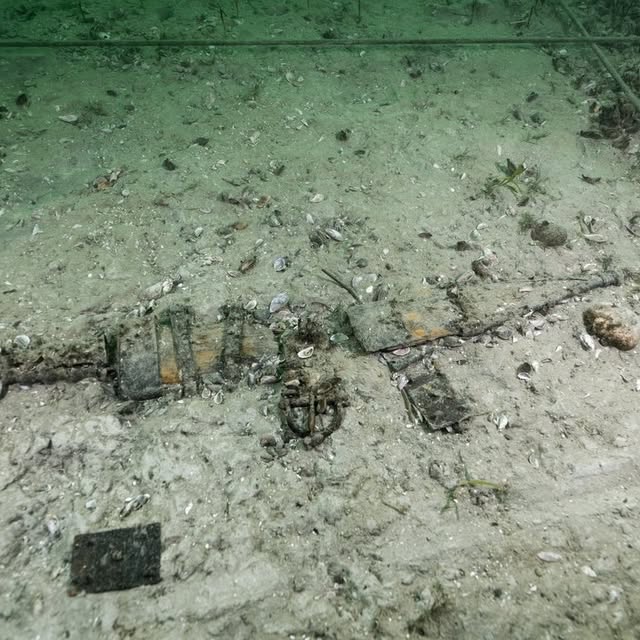
The discovery site was kept secret, and surveillance cameras were installed at the bottom—the cargo lying in Lake Neuchâtel, Switzerland, was too valuable.
A November day in 2024 over Lake Neuchâtel, Switzerland, was unusually clear, which was a good thing for the drones of the cantonal archaeological office, which were just then conducting a routine monitoring of sunken ships. The project had been underway since 2018. The specialists weren't expecting anything out of the ordinary, just a routine check of several points on the seabed. Then the operators noticed an anomaly—something large, perfectly shaped, at a depth of ten meters.
A few days later, scuba divers descended to the object and discovered that the bottom was completely strewn with ancient Roman pottery. Whole plates, bowls, amphorae, cups—hundreds of items, many of which looked as if they had only recently been placed on the seabed. Scuba divers found and carefully raised a wooden element of the ship's planking, of which only an outline remained. Radiocarbon dating revealed a date between 50 BC and 50 AD, meaning the ship sank sometime between the reign of Augustus and the middle of Claudius's reign.
The hull itself was not preserved. Lake water, time, and possibly human activity and currents had all reduced the vessel to scattered pieces of wood. But the cargo it was carrying not only survived but was virtually intact. Approximately six hundred artifacts, and that's just what had been recovered so far. For Switzerland, a country with a rich Roman history but no significant lake shipwrecks, this was an absolute sensation. No inland body of water north of the Alps had yielded anything comparable.
When the first systematic excavations began in March 2025, a 60-by-24-meter area was divided into a grid. In the center lay a dense cluster of ceramics, while around the edges were objects that immediately elevated the find from "interesting" to "historical sensation." These we