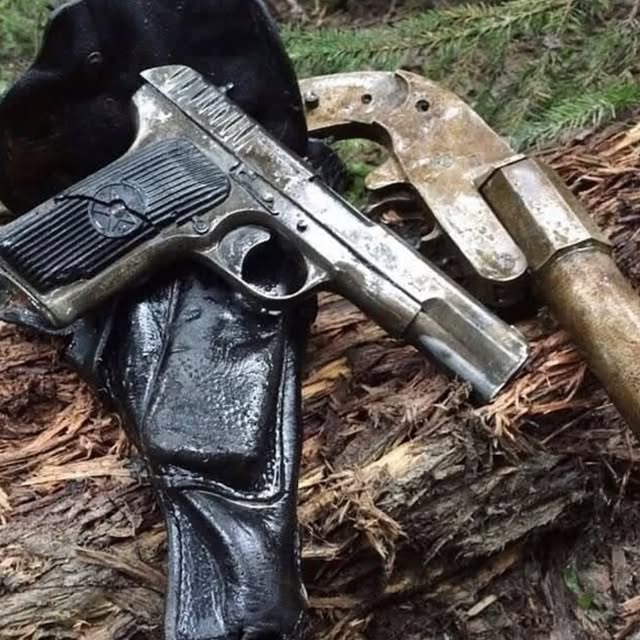
The Real History of the TT Pistol (Tula Tokarev)
The TT pistol, officially known as the 7.62-mm self-loading pistol Model 1933 (TT stands for Tulsky Tokarev — Tula Tokarev), is one of the most iconic Soviet firearms. It was designed by Fedor Vasilyevich Tokarev and adopted by the Red Army to replace the outdated Nagant M1895 revolver.
Development
In the late 1920s, the Soviet military announced a competition for a new semi-automatic service pistol. The requirements were clear: reliability, simplicity in mass production, and compatibility with the 7.62×25 mm cartridge (based on the German 7.63×25 mm Mauser, which was already widely used in the USSR in Mauser C96 pistols).
The TT pistol, officially known as the 7.62-mm self-loading pistol Model 1933 (TT stands for Tulsky Tokarev — Tula Tokarev), is one of the most iconic Soviet firearms. It was designed by Fedor Vasilyevich Tokarev and adopted by the Red Army to replace the outdated Nagant M1895 revolver.
Development
In the late 1920s, the Soviet military announced a competition for a new semi-automatic service pistol. The requirements were clear: reliability, simplicity in mass production, and compatibility with the 7.62×25 mm cartridge (based on the German 7.63×25 mm Mauser, which was already widely used in the USSR in Mauser C96 pistols).
Several designers competed, including Korovin and Prilutsky. Tokarev presented his prototype (initially called TT-30) in 1930. It proved lighter, more accurate, and more reliable than its rivals. After extensive military trials in 1930–1931, it was officially adopted.
In 1933, several improvements were made to simplify mass production:
The removable backstrap of the frame was replaced with an integral one.
Changes were introduced to the barrel, trigger mechanism, and other components.
This resulted in the TT-33 — the main version that entered large-scale production.
In 1933, several improvements were made to simplify mass production:
The removable backstrap of the frame was replaced with an integral one.
Changes were introduced to the barrel, trigger mechanism, and other components.
This resulted in the TT-33 — the main version that entered large-scale production.
The TT uses a short-recoil operated system with a Browning-style locking mechanism (similar to the Colt M1911), but significantly simplified. It is single-action only (no double-action trigger), with an 8-round detachable box magazine.
The 7.62×25 mm Tokarev cartridge is powerful, with high muzzle velocity (around 420–450 m/s), excellent penetration, and a flat trajectory. However, it has relatively low stopping power.
Strengths: Extremely reliable in harsh conditions — mud, snow, dust, and extreme temperatures. Simple and cheap to manufacture.
Weaknesses: No proper manual safety (only a half-cock notch on the hammer), a heavy and somewhat gritty trigger pull, and a risk of accidental discharge if dropped.
The 7.62×25 mm Tokarev cartridge is powerful, with high muzzle velocity (around 420–450 m/s), excellent penetration, and a flat trajectory. However, it has relatively low stopping power.
Strengths: Extremely reliable in harsh conditions — mud, snow, dust, and extreme temperatures. Simple and cheap to manufacture.
Weaknesses: No proper manual safety (only a half-cock notch on the hammer), a heavy and somewhat gritty trigger pull, and a risk of accidental discharge if dropped.